

China’s Diplomatic Breakdown
The Takaichi Comment That Exposed It All (First in a series of three articles)

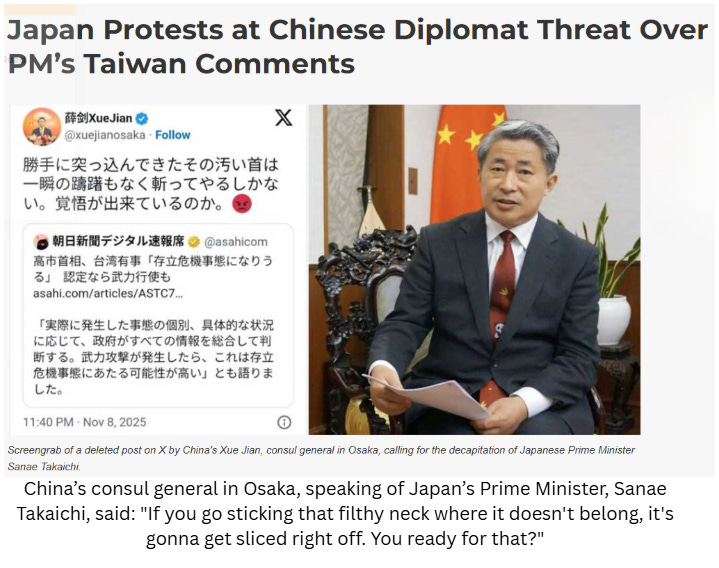
Japan has seen its share of sharp diplomatic exchanges with Beijing, but nothing quite as unhinged as what unfolded after Prime Minister Sanae Takaichi testified before the Diet on November 7. Her statement was measured, legally grounded, and fundamentally consistent with Japan’s existing security legislation: if China were to impose a naval blockade on Taiwan using force in a way that directly threatens Japan’s sea lanes such a crisis “could constitute a survival-threatening situation” for Japan. That determination would open the door to a limited exercise of collective self-defense. It was, in truth, exactly what former Prime Minister Abe had articulated years earlier.
But this time, China erupted.
On November 8, Xue Jian, the Chinese Consul General in Osaka, posted a threat so crude that Tokyo (and the world) is still trying to process it: of Takaichi, he said, China would “cut off that dirty neck.” Even by the degraded standards of wolf-warrior diplomacy, this crossed a line. The post, quickly deleted, ignited a diplomatic firestorm and exposed something deeper and far more revealing about China’s internal political unraveling.
For nearly two years, Xi Jinping has been steadily losing real power. His grip over the military has loosened, senior officers have been purged or sidelined beyond his control, and his long-standing provincial bases in Fujian, Zhejiang, and Shaanxi have slipped away. The overreaction to Takaichi was not the move of a confident leader, it was the lashing out of a man desperate to salvage his collapsing authority.
The contrast with Xi’s own father could not be more striking. As Guangdong’s leader in the 1980s, Xi Zhongxun championed enlightened, pragmatic policies—opening the Special Economic Zones to Taiwan investment and creating the single most successful period of cross-strait goodwill in modern history (see WideFountain’s article January 6, 2025, juxtaposing Xi Father & Son). Today, the son’s hardline tactics in Xinjiang, Hong Kong, and Taiwan have backfired so dramatically that even Beijing insiders now whisper openly of their failure. The recent removal of two of Xi’s key loyalists, Ma Xingrui in Xinjiang and Zheng Yanxiong in Hong Kong, signals a broader disenchantment inside the system.
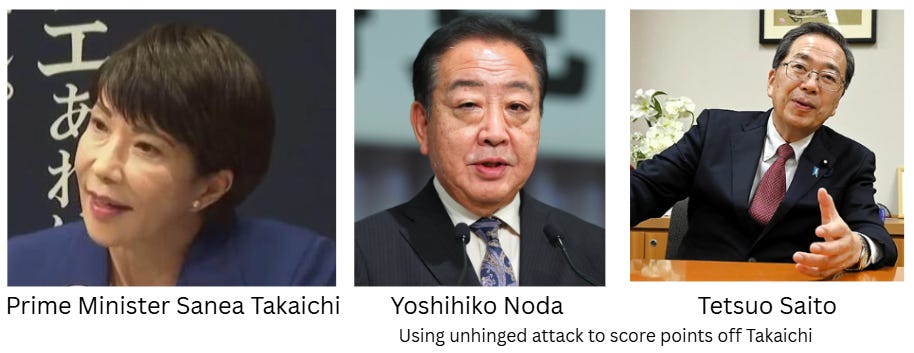
Yet instead of introspection, Beijing chose intimidation. And, regrettably, some in Japan’s Diet seemed more eager to score domestic political points than to defend their country’s dignity. On November 26, opposition leaders grilled Takaichi as though she, not the Chinese consul issuing violent threats, were responsible for the deterioration in relations. This is the kind of self-doubt Beijing counts on.
Japan’s leaders can debate policy vigorously, but not at the expense of national pride or strategic clarity. The real danger here is not Takaichi’s harmless testimony, it is a faltering Chinese leader trying to externalize his political crisis.
Japan should not play along, no country should.
This is not the first time the PRC has tried to isolate nations, industries, companies and individuals for "punishment" when there is a failure to adhere to the PRC's censorious wishes. Hopefully this latest episode with Japan should be a wake up call to those who are still asleep to the dangers current PRC leadership poses. An attempt to coerce or force Taiwan into a "one country two systems" farce would be a travesty to the people in Taiwan, the vast majority of whom do not want to come under CCP authoritarian rule. It would also be globally destabilizing. It is essential that countries who value open societies unite and send a strong message that PRC aggression and expansionism will provoke a collective response. "Reunification" should only occur under mutually agreeable terms, which is clearly not possible now or in the foreseeable future. Current CCP leadership has only itself to blame for its handling of Hong Kong and aggressiveness towards Taiwan.